Agumbe Ghat: Protect the Western Ghats, Do Not Destroy Them
By Benedict Fernandes
There is a serious misunderstanding growing around Agumbe Ghat. Many believe development means widening roads, blasting hills, and carving tunnels through one of the most sensitive ecosystems in India. That is not development. That is short sighted thinking.
The Real Cause of Traffic Problems
The present road through Agumbe is not inadequate. The real problem is not width. It is management.
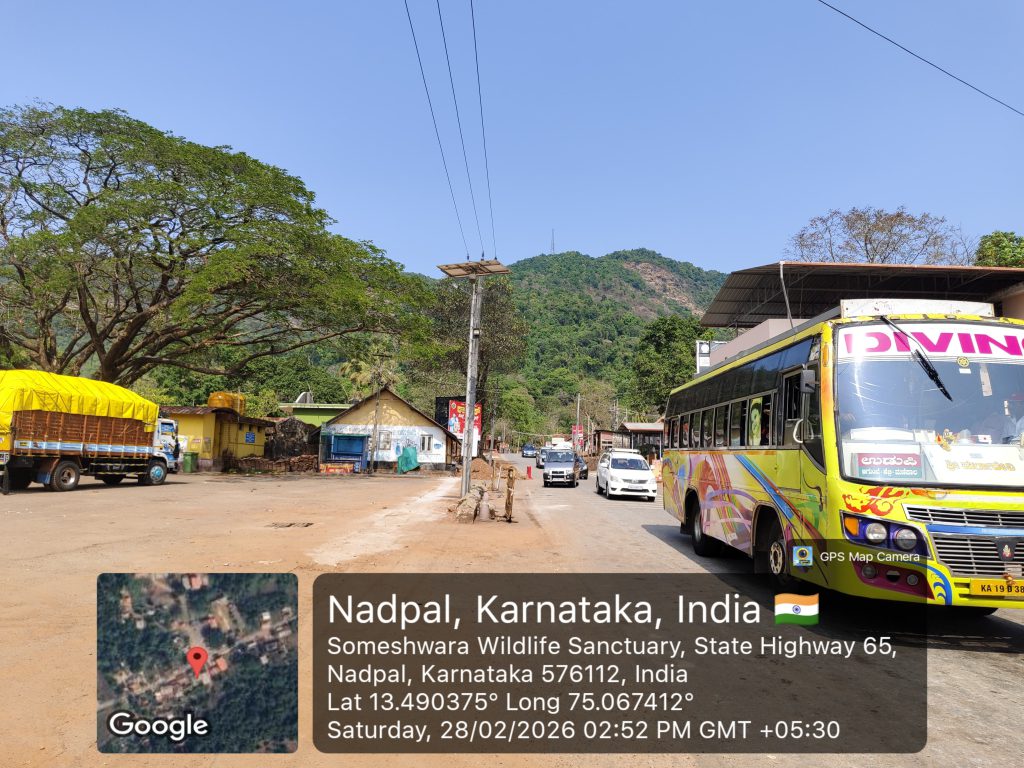
At the sixth, seventh, and eighth hairpin bends, vehicles coming uphill from the Udupi side must be given priority. Experienced local drivers understand this. Tourists and occasional visitors often do not. When large buses, tippers, or overloaded vehicles descend aggressively, they block the turns. Engines stall. Vehicles struggle to restart. Confusion follows.
The result is clear:
Traffic jams
Delays for ambulances and emergency services
Frustration for local residents
Heavy congestion during weekends
This is not a failure of road design. It is a failure of discipline and regulation.
Why Agumbe Is Ecologically Sensitive
Western Ghats is one of the world’s most important biodiversity regions.
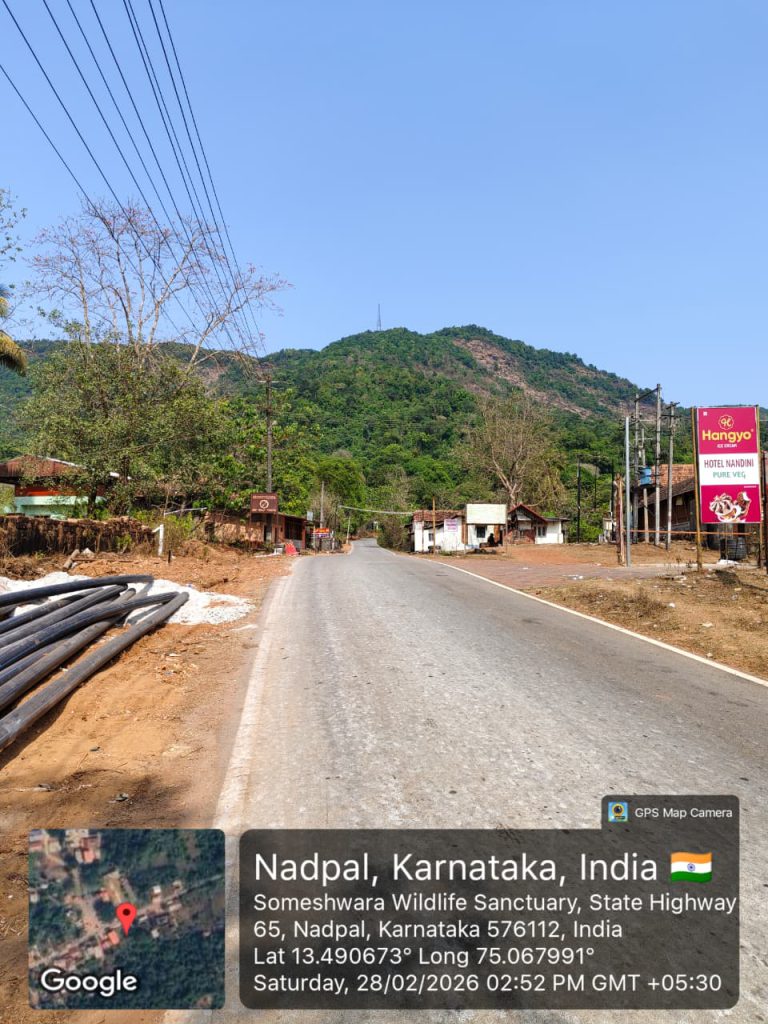
Someshwara Wildlife Sanctuary surrounds this landscape with dense rainforest, rare wildlife, fragile slopes, and intense monsoon rainfall.
Agumbe is not merely a scenic route. It is
A rainforest ecosystem
A water source region
A wildlife corridor
A landslide prone mountain terrain
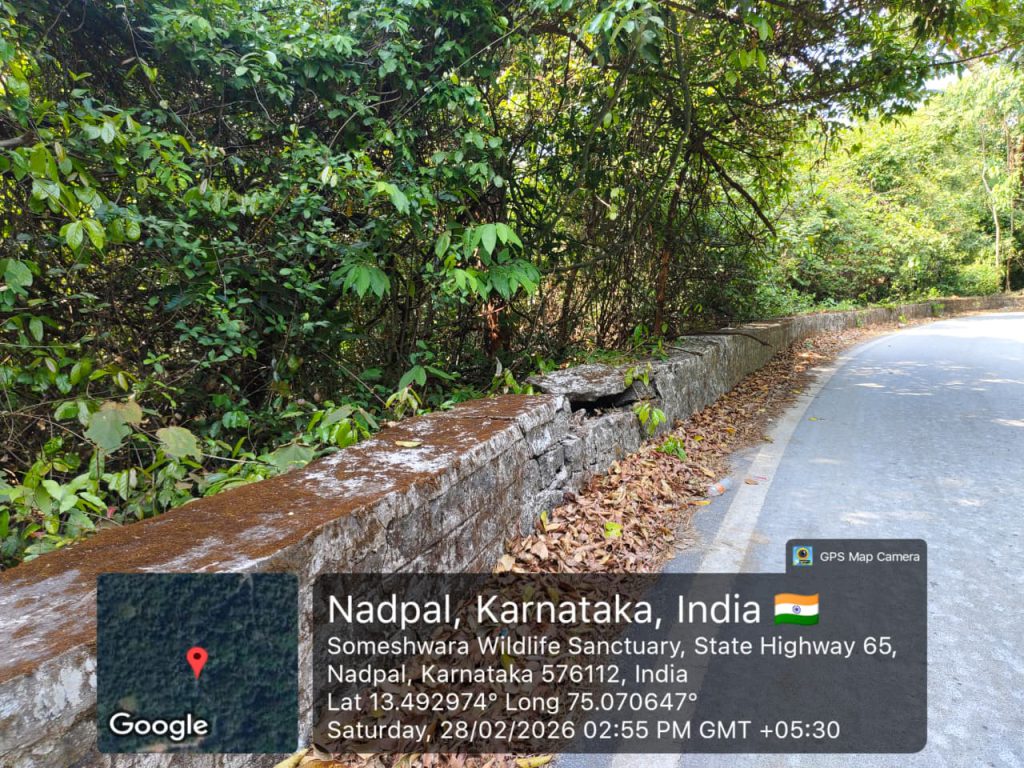
Heavy rainfall combined with disturbed slopes leads to landslides. Deforestation combined with road expansion leads to erosion and habitat loss. Blasting for tunnels leads to irreversible ecological damage. A destroyed mountain cannot be rebuilt.
Practical and Responsible Solutions
If the goal is safety and smoother traffic, the solutions are simple and achievable.
Traffic personnel at critical bends
Two trained staff members at bends six, seven, and eight during peak hours can prevent most congestion. Coordination can solve what concrete cannot.
Repair and strengthen the existing road
Close potholes
Reinforce embankments
Repair barriers from bends six to thirteen
Improve drainage systems
Maintenance is smarter and more economical than demolition.
Regulate heavy and illegal transport
Illegal sand, stone, and other goods transport must be strictly stopped. Large tourist buses should be controlled.
Alternative routes already exist
Hulikal Ghat
Kerekate Ghat
There is no need to overload a fragile rainforest pass when other roads are available.
Use eco engineering methods
Geo grid reinforcement and bio engineering slope stabilization can strengthen the existing road without harming the environment.
Work with nature. Do not fight against it.
Enforce speed control
The growing habit of speeding on ghats is dangerous. Strict monitoring and penalties are necessary. Mountains demand caution and respect.
Development Must Mean Protection
A two lane expansion or tunnel in Agumbe is not a necessity. It risks permanent damage to a sensitive region of the Western Ghats.
Public money should be used to improve safety, enforce law, and protect biodiversity. It should not fund projects that permanently scar a living rainforest.
True development improves safety while protecting ecosystems.
True development respects geography and science.
True development solves real problems without creating irreversible damage.
Agumbe is a living rainforest system that supports wildlife, water, and communities. If we fail to protect such places, we fail future generations. The choice is simple. Reform and regulate. Strengthen what exists. Protect the mountain. Nature does not need bigger roads. It needs wiser decisions.
St Aloysius (Deemed to be University) Launches 24 7 AI Admissions Assistant Maria to Transform Student Enrollment Experience
NV Paulose, Chairman, Global TV +91 98441 82044
Mangaluru, India — In a significant step toward digital innovation in higher education, St Aloysius Deemed to be University has unveiled Maria, a 24 7 AI powered admissions assistant designed to simplify and modernize the student enrollment process.
The university, established in 1880 and long recognized for academic excellence, is positioning itself at the forefront of smart campus initiatives with this latest launch. Maria aims to eliminate confusion, delays, and uncertainty often associated with admissions by providing instant, round the clock guidance to prospective students.
A Smart Solution for Admission Queries
Choosing the right course is one of the most critical decisions in a student’s academic journey. Maria addresses this challenge by offering immediate assistance on course options and eligibility requirements, fee structures and payment details, career guidance and program outcomes, and step by step admission procedures.
Unlike traditional inquiry systems that rely on office hours or delayed email responses, Maria ensures that students and parents receive answers anytime through call, website, or WhatsApp. This real time accessibility allows applicants to move forward with clarity and confidence.
Reducing Pressure and Increasing Clarity
University officials describe Maria as part of a broader strategy to reduce barriers in access to information. The AI assistant is designed to provide clear and structured responses, helping applicants make informed decisions without the stress of waiting for callbacks or scheduling campus visits.
By integrating automation into admissions support, the institution is responding to the expectations of digitally native students who prefer instant and on demand communication. At the same time, the university emphasizes that Maria complements the admissions team, ensuring that complex or personalized queries are handled directly by experienced staff when necessary.
Driving the Smart University Vision
The launch aligns with the university’s larger vision of becoming a Smart University powered by technology driven systems. As higher education institutions across India adapt to digital transformation, St Aloysius is leveraging artificial intelligence to enhance operational efficiency and student experience.
Education analysts note that AI powered admissions tools are increasingly becoming standard among forward looking institutions. However, their effectiveness depends on accuracy, responsiveness, and responsible human oversight. In this regard, the university has ensured that Maria operates within a monitored framework that prioritizes reliability and student trust.
Leadership Perspective
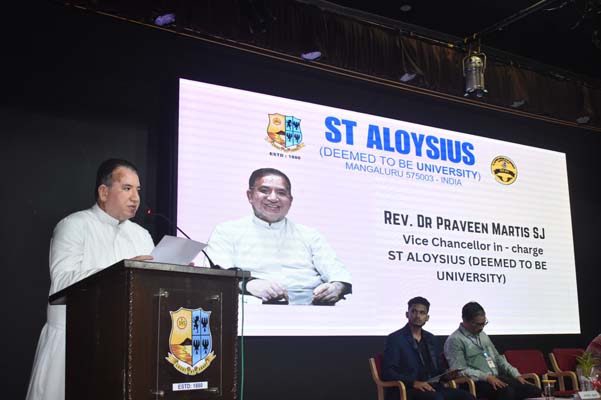
Speaking to Global TV, Rev. Dr. Praveen Martis SJ, Vice Chancellor of St Aloysius Deemed to be University, stated that the launch of Maria reflects the institution’s commitment to innovation while remaining deeply student centered. He emphasized that technology must serve people, and that Maria is designed to make the admission journey transparent, accessible, and supportive for every applicant.
He further noted that the university continues to invest in digital systems that enhance both academic delivery and administrative efficiency, reinforcing its position as a progressive institution rooted in strong educational values.
Dynamic Growth and Institutional Progress
In recent years, St Aloysius has witnessed dynamic growth across academic programs, research initiatives, and infrastructure development. The university has expanded interdisciplinary offerings, strengthened industry collaborations, and enhanced global academic partnerships. Upgraded laboratories, modern learning spaces, and student support systems reflect a forward moving institution committed to excellence.
With the introduction of Maria, the university underscores a clear message that admissions should be smart, simple, and student focused. As it continues its journey of transformation, St Aloysius Deemed to be University demonstrates how tradition and technology can work together to shape the future of higher education.
Three in One Campaign | Success Storytelling | Opportunity Creation| Revenue Generation | Equitable Sharing | Join the Drive | +91 95443 54941
Are you the one who are concerned about the wellbeing of others and the society as a whole? This is a career opportunity for you.
Doing good unto others is the greatest profession and occupation in the world because it carries purpose beyond position. It demands no fixed salary, yet it generates rewards far greater than ordinary work.
When we serve others sincerely, our referral circle expands, trust deepens, and opportunities multiply. Such people remain active professionally while leading impactful service initiatives.
Their goodwill becomes social capital, opening doors that money alone cannot. They earn respect, influence, and sustained success; often far exceeding the usual professional returns.
Every act of kindness compounds into credibility and growth. By uplifting others, they build abundance, fulfillment, and lasting prosperity.
A Life Dedicated to Letters Language and Journalism
NV Paulose, Chairman, Global TV +91 98441 82044
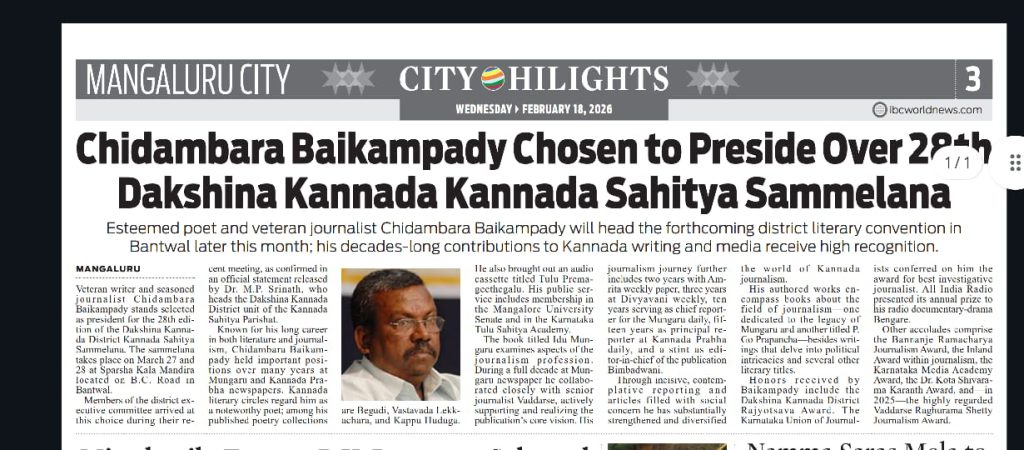
MANGALURU: The selection of Chidambara Baikampady as President of the 28th Dakshina Kannada Kannada Sahitya Sammelana is a moment of profound significance for the literary and journalistic community of the region. The prestigious district literary convention will be held on March 27 and 28 at Sparsha Kala Mandira B C Road Bantwal under the guidance of a personality whose life work reflects intellectual depth cultural commitment and social responsibility.
The decision was taken unanimously by the district executive committee of the Kannada Sahitya Parishat and formally announced by Dr M P Srinath President of the Dakshina Kannada District Unit. This choice stands as recognition not only of seniority but of a lifetime devoted to Kannada language literature and ethical journalism.
A Distinguished Literary Voice
Widely respected as a thoughtful and original poet Chidambara Baikampady has enriched Kannada literature through acclaimed poetry collections such as Begudi Vastavada Lekkachara and Kappu Huduga. His creative engagement also extends into Tulu culture notably through the audio cassette Tulu Prema Geethegalu which continues to resonate strongly with regional audiences.
His literary expression is marked by emotional depth social awareness and philosophical clarity qualities that have earned him enduring respect among scholars writers and readers.
Architect of Responsible Journalism
Chidambara Baikampady has also made an indelible mark on Kannada journalism through decades of principled and influential work. He has served in pivotal editorial and reporting roles at leading publications including Mungaru and Kannada Prabha.
His professional journey includes two years with Amrita weekly three years at Divyavani weekly ten years as Chief Reporter at the Mungaru daily fifteen years as Principal Reporter at the Kannada Prabha daily and service as Editor in Chief of the publication Bimbadwani.
His close association with Mungaru during a defining decade alongside senior journalist Vaddarse played a crucial role in shaping the publication vision and credibility. His reflective work Idu Mungaru offers valuable insight into the ethics challenges and responsibilities of the journalism profession.
Through incisive reporting and articles infused with social concern he has significantly strengthened and broadened the scope of Kannada journalism.
Scholar Administrator and Cultural Contributor
Beyond journalism and creative writing Baikampady has contributed meaningfully to academic and cultural institutions. He has served as a member of the Mangalore University Senate and the Karnataka Tulu Sahitya Academy. His authored works include books on journalism political discourse and cultural analysis including P Go Prapancha and other notable titles.
A Legacy of Recognition
Chidambara Baikampady work has been acknowledged with numerous prestigious honors including the Dakshina Kannada District Rajyotsava Award the Best Investigative Journalist Award from the Karnataka Union of Journalists and the All India Radio annual award for the radio documentary drama Bengare.
Other significant accolades include the Bannanje Ramacharya Journalism Award the Inland Journalism Award the Karnataka Media Academy Award the Dr Kota Shivarama Karanth Award and the highly respected Vaddarse Raghurama Shetty Award received in 2025.
A Fitting and Meaningful Choice
The appointment of Chidambara Baikampady as President of the 28th Dakshina Kannada Kannada Sahitya Sammelana is a tribute to a life that has consistently upheld the power of language the responsibility of journalism and the cultural soul of Karnataka.
Under his leadership the Sammelana is expected to stand as a celebration of Kannada intellectual tradition and a reaffirmation of values that guide literature and public life.
It is the complete absence of common sense and it is still waiting to be admitted.
NV Paulose, Chairman, Global TV +91 98441 82044
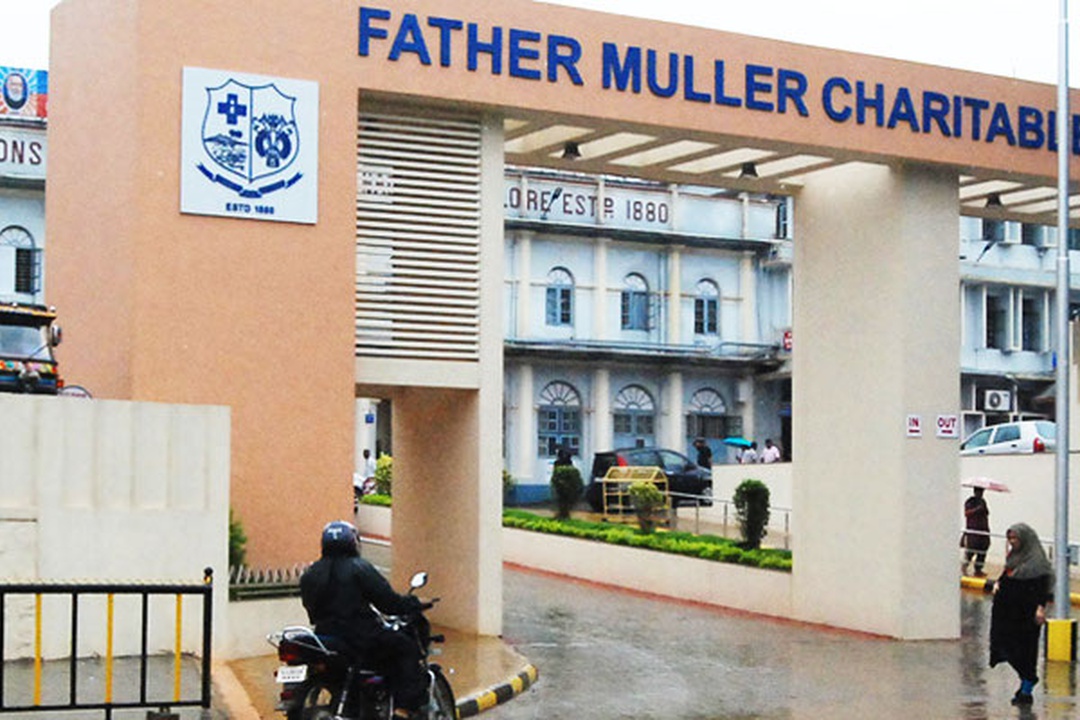
At Father Mullers Hospital, healing is considered a noble duty. However even nobler than healing is Procedure. Procedure does not sweat. Procedure does not hurry. Procedure does not improvise. Procedure does not bend to reality. Procedure exists for its own comfort and expects everyone else to adjust.
The patient arrives at the emergency ward on clear instruction from a practicing doctor. This is not a suggestion. It is not an experiment. It is a professional medical decision. One would reasonably assume that an emergency ward might treat such an arrival with urgency or at least with alertness. Instead the ward responds with calm meditation and a noticeable absence of speed.
Time stretches. The patient waits. Staff move with a seriousness that suggests importance but not urgency. The emergency ward seems to believe that emergencies are theoretical concepts rather than real situations involving real people.
Enter the family friend who brings the patient in. He completes the admission and responsibly informs the nurse that he is available on the phone. He steps out briefly. This is not abandonment. This is normal adult behavior in a world where mobile phones exist and hospitals are staffed by professionals. The nurse insists that a bystander must be present.
Why must a bystander be present
What exactly will the bystander do
Will the bystander administer treatment
Will the bystander improve vital signs
Will the bystander speed up the emergency process
These questions are not asked because questions are dangerous in the presence of Procedure. The family friend explains calmly that his physical presence is not required. The patient is stable. The hospital staff are trained. He has arranged food and will return shortly. This explanation makes sense which is precisely why it fails.
Procedure does not respond to sense. Procedure responds only to rules whose origins have long been forgotten.
Food now becomes the next challenge. The emergency ward offers no comfortable space for a patient to eat despite the fact that waiting for hours appears to be standard practice. Eventually even Procedure concedes a small victory to logic. The nurse and the bystander agree that the patient should eat in the room.
For a brief moment common sense enters the building. The bystander walks ahead to prepare the room. This is practical. This is efficient. This is adult behavior. Then the nurse insists that he must accompany the patient. The bystander says it is not necessary. He is going to the same room. The destination is identical. The timing difference is negligible. There is no risk involved.
He goes to the room. This is where the tone shifts.
Suddenly with remarkable energy and speed the nurse decides that the patient must be taken to the X ray room. Even more suddenly the bystander must return immediately. The emergency ward which previously had all the urgency of a relaxed afternoon now moves with purpose.
One cannot help but wonder
Is this medical necessity or administrative irritation
Is this patient care or procedural punishment
Is this healthcare or a power demonstration
The timing is impressive. The motivation is questionable.
Earlier the bystander was unnecessary. Now he is essential. Earlier food was important. Now imaging is urgent. Earlier time did not matter. Now time matters very much but only when enforcing attendance.
What kind of tradition is this
Is this what Florence Nightingale envisioned
Did she insist on constant physical presence of relatives before allowing care
Did she delay treatment to enforce obedience
The emergency ward becomes a stage where Procedure is the main character. The patient becomes a supporting role. The bystander becomes a movable object whose purpose is to stand exactly where instructed.
Common sense waits quietly outside without an identity card.
This is not about one nurse or one moment. This is about a system where rules exist without explanation and are enforced without reflection. A system where responsibility is confused with proximity and care is confused with compliance.
The irony is hard to miss. The emergency ward moves slowly when the patient needs attention and swiftly when authority feels challenged. Energy appears not when pain demands it but when Procedure feels disrespected.
No one explains why the bystander must be present. No one explains how his presence changes the outcome. No one explains why logic is negotiable but rules are absolute.
The patient eventually receives care. The bystander eventually complies. Procedure remains undefeated. Everyone leaves with a story. The patient leaves relieved but exhausted. The bystander leaves wiser and less trusting. The system remains unchanged and very proud of itself.
This is not a story about incompetence. It is a story about misplaced priorities. It is about how systems meant to serve people slowly begin to serve themselves. It is about how rules designed for safety become obstacles to care when they are followed without thought.
In the end the emergency ward treats the illness adequately. What it fails to treat is the deeper problem. Because the real emergency here is not medical.
It is the complete absence of common sense and it is still waiting to be admitted.
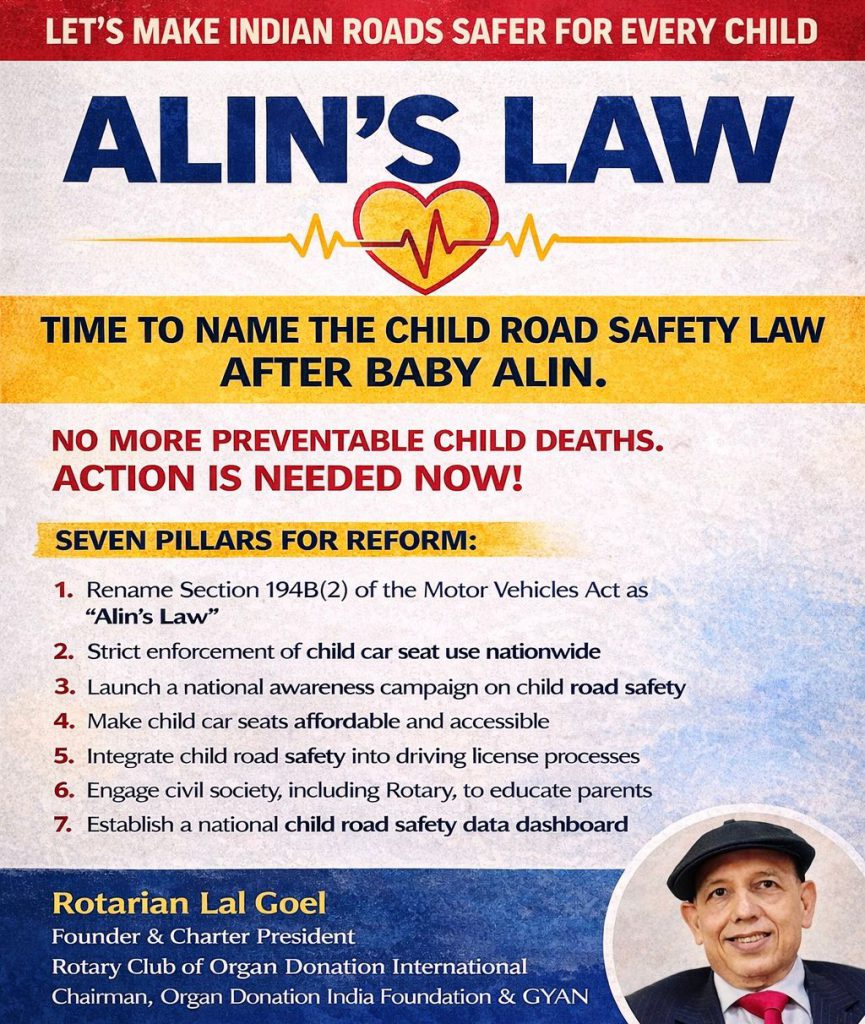
KERALA’S 10-MONTH-OLD BABY ALIN’S ACCIDENTAL DEATH: | A WARNING TO SOCIETY AND A CALL FOR A SAFER FUTURE
By Rotarian Lal Goel | Founder & Charter President | Rotary Club of Organ Donation International | Chairman: Organ Donation India Foundation & GYAN
The Tragedy That Shook a Nation
The recent accidental death of 10-month-old Baby Alin from Kerala has sent a wave of grief and introspection across India. While the nation has united in profound praise for the parents’ selfless decision to donate their infant’s organs — a noble and life-giving act — this tragedy demands that we also pause and ask a harder question: Could this death have been prevented? The answer, according to the law of the land and the evidence of road safety science, is an unambiguous yes. Baby Alin did not have to die. And therein lies the urgent warning this tragedy holds for every family in India.
The Law That Was Ignored Section 194B(2) of the Motor Vehicles Act mandates the use of child restraint systems — commonly known as car seats — for young children travelling in motor vehicles. This is not a suggestion. It is a legal obligation, enacted specifically to prevent fatalities like the one that claimed Baby Alin’s life. Globally, road traffic injuries are a leading cause of death among children under five. Properly installed child car seats reduce the risk of death in a crash by up to 71% for infants. This is not merely statistics — it is the science of survival. When a vehicle is involved in a collision, an unsecured infant becomes a projectile. No parent’s arms, however strong, can hold a child safely against the physics of a crash. Baby Alin’s parents, like countless Indian parents, may not have been aware of this law. Or perhaps, like many others, they may have considered it unnecessary for a short trip. This is the cultural blind spot that India must urgently address.
Organ Donation: Noble Act, Difficult Context As someone deeply involved in organ donation advocacy, I believe organ donation is a noble, life-saving act. But organ donation should never become a consolation prize for preventable negligence. A life saved through donation is sacred — but a life lost due to avoidable carelessness is a societal failure. The decision of Baby Alin’s parents to donate her organs is, without question, an extraordinary act of compassion. Lives have been saved as a direct result. The nation’s gratitude is appropriate and sincere. However, praising this act without equally acknowledging the preventable circumstances of the death risks sending a dangerous signal to society. It must be said clearly — not to punish grieving parents already devastated by loss — but as a societal learning: the tragedy began with non-compliance with a law designed to protect children. A society that mourns avoidable child deaths while turning a blind eye to the cause does a disservice to every child yet to be born.
The Larger Issue: Prevention Before Donation India continues to struggle with compliance with road safety regulations. According to global road safety data, India accounts for one of the highest numbers of road fatalities in the world. Yet child car seat usage in India remains extremely low, enforcement of child restraint laws is weak, public awareness about infant road safety is minimal, and many parents wrongly believe holding a baby in arms is safe. In contrast, countries like the United Kingdom, Australia, and the United States enforce strict child restraint regulations with heavy penalties and strong public education campaigns. Compliance is high because enforcement is real. India cannot afford symbolic laws. We need cultural change backed by enforcement.
A Roadmap for the Future: Seven Pillars of Child Road Safety If Baby Alin’s death is to carry meaning beyond grief, it must catalyse systemic change. The following roadmap outlines concrete, actionable steps for government, civil society, and every Indian family.
Rename Section 194B(2) as “Alin’s Law” — and Enforce It In the United Kingdom, the landmark organ donation legislation is known as Max and Keira’s Law, named after Keira Ball, a nine-year-old whose organs saved the life of Max Johnson, among others. The law carries their names because their story made it real, gave it a human face, and ensured that the public would remember not merely a legal provision but a child. That is the power of naming a law after those whose lives gave it meaning. India should do the same. Section 194B(2) of the Motor Vehicles Act — the child restraint law that, had it been followed, might have saved Baby Alin — must be formally designated Alin’s Law. This is not a symbolic gesture alone. It is the most meaningful homage a nation can pay to a child who cannot speak for herself. Every time a traffic officer checks for a car seat, every time a parent reads a road safety notice, every time a hospital hands new parents a safety leaflet, the name Alin should be present. She should be remembered not only as a donor, but as the child whose death became the turning point that made Indian roads safer for every infant who follows her. The Motor Vehicles Act’s child seat mandate under Alin’s Law must move from paper to practice. Traffic police across India must be trained, equipped, and directed to check for child restraint systems as part of routine enforcement. Fines must be meaningful, consistent, and applied without exception. A law that is not enforced is no law at all — and a law that bears a child’s name carries a moral weight that demands it be taken seriously.
A National Awareness Campaign The Ministry of Road Transport and Highways, in partnership with state governments, should launch a sustained, multilingual public awareness campaign on child road safety. Hospitals, maternity wards, and paediatricians should be enlisted as frontline educators — informing new parents about car seat requirements before they leave the hospital with their newborn for the very first time. This campaign should carry Baby Alin’s name and story at its heart.
Affordable Access to Child Car Seats One significant barrier to compliance is the cost of quality child car seats, which can be prohibitive for low- and middle-income families. The government should consider subsidising car seats for economically weaker sections, reducing GST on child safety equipment, and encouraging domestic manufacturing to bring prices down. Safety must not be a privilege of the affluent.
Integration into Driving Licence and Vehicle Registration Processes Child safety information should be embedded into the process of obtaining a driving licence and registering a vehicle. Every new driver must be tested on child passenger safety laws. Vehicle registration renewal communications should include child safety reminders. These are low-cost, high-impact interventions.
Civil Society and Rotary Engagement Organisations like Rotary International, with its deep roots in communities across India, have a vital role to play. Rotary clubs can organise free child seat installation clinics, community education drives, and distribute informational materials in local languages. Civil society can bridge the gap between government mandates and ground-level behaviour change.
Media Responsibility The media, which rightly celebrated the family’s generosity in organ donation, must also fulfil its responsibility to inform. Every report on child road fatalities should mention Alin’s Law and the life-saving statistics that back it up. Journalism that informs is journalism that protects.
A Data-Driven National Child Road Safety Dashboard India should establish a publicly accessible, state-wise dashboard tracking child road traffic fatalities and injuries, car seat compliance rates, and enforcement statistics. What is measured is managed. Transparency drives accountability, and accountability drives change. Conclusion: Let Alin’s Life Be a Turning Point Baby Alin lived for only ten months. In her brief time on earth, she gave life to others through the gifts her parents chose to offer. But civil society owes her something too — the commitment that no other child will needlessly die in a car because parents did not know, or did not comply with, the law. In Britain, Max and Keira’s Law changed how the nation thinks about organ donation. In India, Alin’s Law must change how a nation protects its children on the road. That is a legacy worthy of her name. Let us honour Baby Alin not only with tears and praise for her parents’ generosity, but with action. Let every parent who reads this story buckle their child in. Let every government official enforce Alin’s Law. Let every hospital educate new parents in her name. Let every Rotarian spread the word. A society is measured not by how it mourns its lost children, but by how fiercely it protects the living ones. Baby Alin’s death is a warning. Let us heed it. — Rotarian Lal Goel
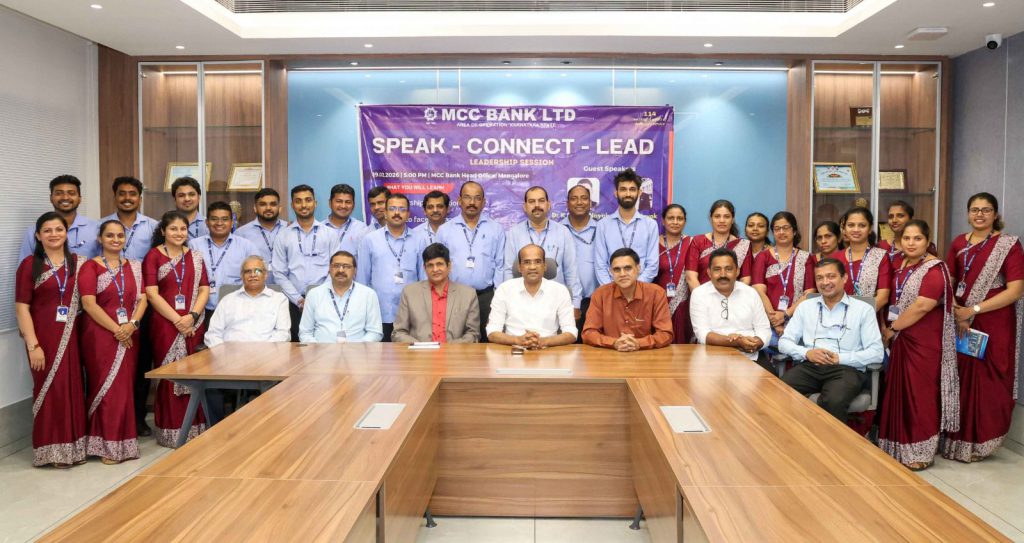
MCC Bank Conducts Leadership Session for Management and staff
NV Paulose, Chairman, Global TV +91 98441 82044
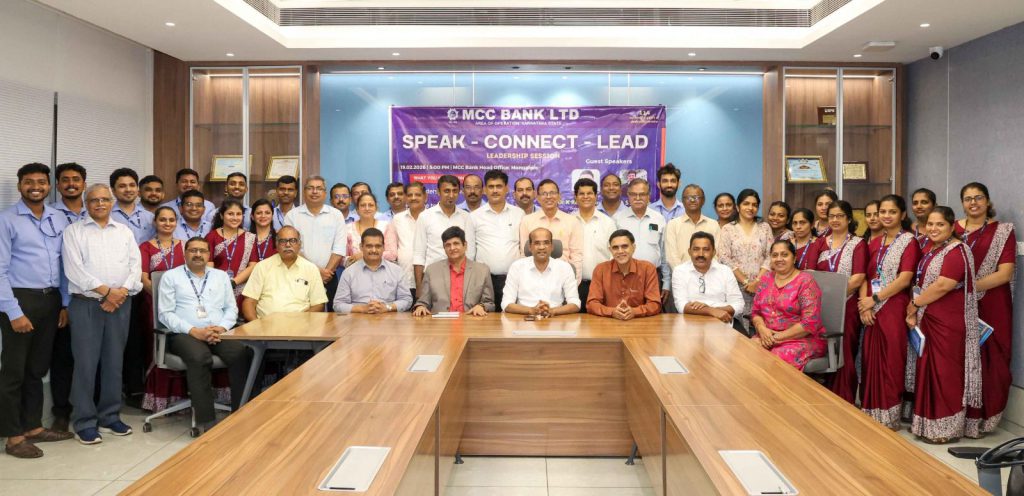
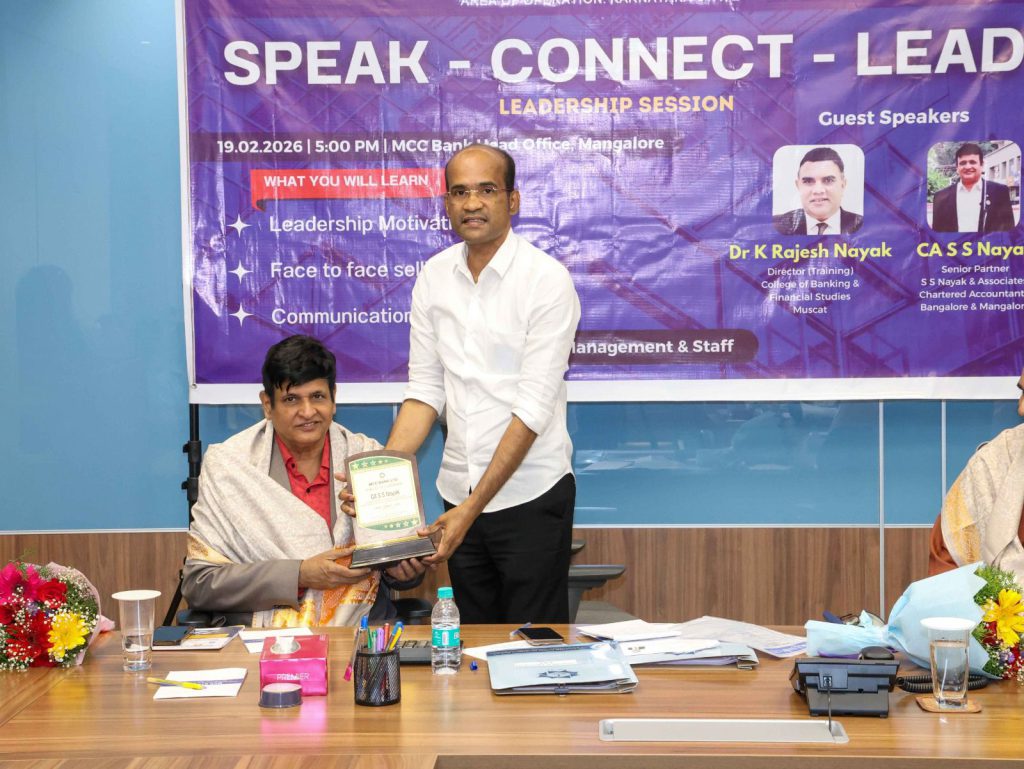
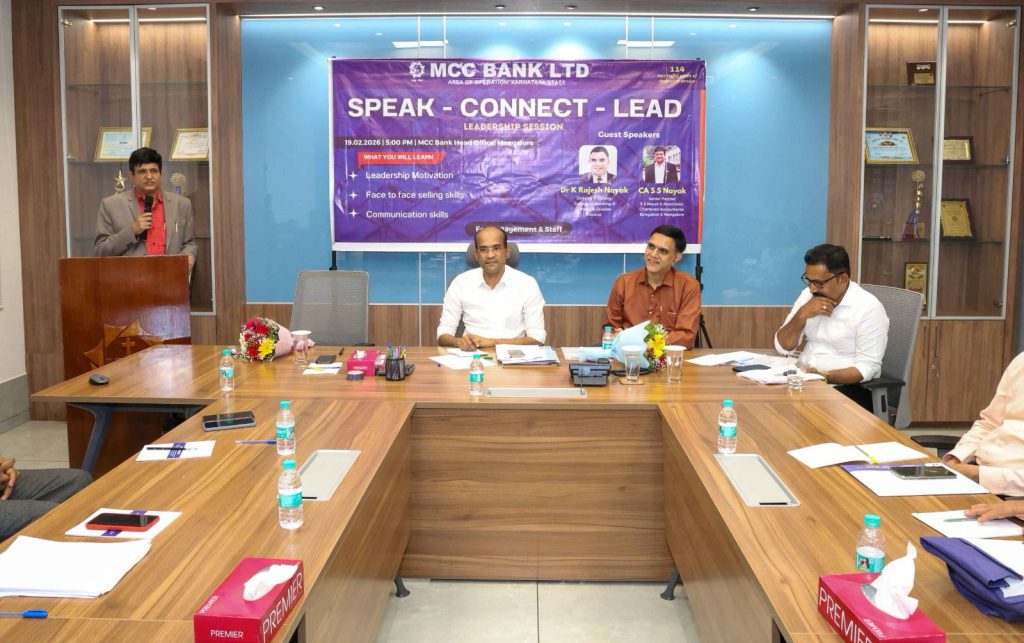
MCC Bank organized a Session on leadership motivation, face-to-face selling skills, and communication skills titled “Speak, Lead and Connect” on 19th February 2026 at the Board Meeting Hall of its Head Office in Mangalore. Sahakara Ratna Shri Anil Lobo welcomed the distinguished guests with floral bouquets. The guest speakers for the session were Dr. K. Rajesh Nayak, Director – Training at the College of Banking and Financial Studies, Muscat, and CA S. S. Nayak, a renowned Chartered Accountant and expert in taxation, entrepreneurship, and business advisory services.
CA S.S. Nayak, in his session, stated that the Indian banking system is the number one in the world, highlighting its resilience, regulatory strength, and adaptability in a rapidly evolving financial landscape. He emphasized that banks should address customer complaints first before pursuing new business opportunities, as resolving concerns builds credibility, strengthens trust, and lays a solid foundation for growth.
He further mentioned that the limitations and regulatory requirements relating to the digitalization of the cooperative banking sector have now been duly addressed, enabling institutions to move forward with greater confidence in adopting technological advancements. He also stated that compliance is a higher priority than business expansion.
Explaining the exact meaning of KYC (Know Your Customer), he stressed that it involves truly knowing and understanding customers rather than merely verifying their Aadhaar and PAN cards. He also elaborated on taxation aspects applicable to Indian residents and NRIs.
He advised Managers to “know your bank, know your product, know your competitor, and know your limitations,” and encouraged them to work hard, noting that there are ample opportunities in Dakshina Kannada and Udupi districts. He urged branch managers and staff to work together to achieve their targets.
He concluded by stating that successful people show results, whereas unsuccessful people give reasons. He explained the “10-30-10 technique,” whereby approaching 10 existing customers and obtaining three references from each can lead to 30 prospects; from 30 prospects, at least 10 can be converted into customers. He also discussed effective customer handling and emphasized that customer complaints should be resolved at the branch level itself.
Finally, he explained the concepts of Management by Objectives and Management by Exception. He concluded by quoting a Sanskrit-inspired saying: “Desire changes nothing, decision changes something, and dedication changes everything.”
Dr. K. Rajesh Nayak emphasized the importance of building trust in the Bank, stating that trust is the foundation upon which lasting customer relationships and sustainable growth are established. He encouraged participants to strengthen their listening skills, explaining that effective listening not only improves customer understanding but also enhances problem-solving and service delivery.
He remarked that while technology and artificial intelligence are advancing rapidly, human skills continue to play a far more powerful role in banking, as empathy, judgment, and personal connection cannot be replaced. He cautioned everyone never to underestimate anyone’s abilities and stressed the need to continuously build knowledge and competence. He further stated that knowledge and wisdom are essential qualities of a good leader, and that common sense is equally important for everyone.
In his presidential address, Chairman Sahakara Ratna Shri Anil Lobo emphasized the importance of leadership excellence in strengthening the foundation of the organization. He highlighted that true leadership is reflected not only in decision-making but also in the ability to inspire confidence and build lasting relationships with customers. Stressing a customer-centric approach, he remarked that service should always be delivered with a positive attitude, as positive interactions create trust and foster long-term loyalty.
He also underscored the significance of setting clear targets and consistently monitoring performance through regular follow-ups to ensure steady progress. According to him, professionalism in approach, disciplined execution, and accountability at every level are essential for achieving organizational goals. He encouraged all members to remain committed, focused, and performance-driven in order to meet and exceed their targets while upholding the highest standards of service. He thanked the guest speakers for their valuable advice to the Management and staff.
On behalf of the Board of Directors, Mr C.G. Pinto, Professional Director, expressed his sincere gratitude to the guest speakers for their insightful and enlightening sessions. He appreciated the initiative taken by the Chairman in inviting such distinguished professionals to address the Board of Directors and staff, stating that their expertise and practical guidance would greatly benefit the institution in strengthening its leadership capabilities and enhancing overall performance.
The Managers appreciated the sessions, stating that the insights shared by the speakers would help them grow further, achieve their targets, and strengthen customer service. Accountant Mr Alwyn D’Souza compered the programme and proposed the vote of thanks. As a token of gratitude, the Chairman honoured the guest speakers with shawl and memento. The Chairman, Vice Chairman, Directors, top officials from the Head Office, Branch Managers, and senior officials attended the session.
Infant Jesus Shrine, Bikarnakatte Prays for Students as Examinations Approach
NV Paulose, Chairman, Global TV +91 98441 82044
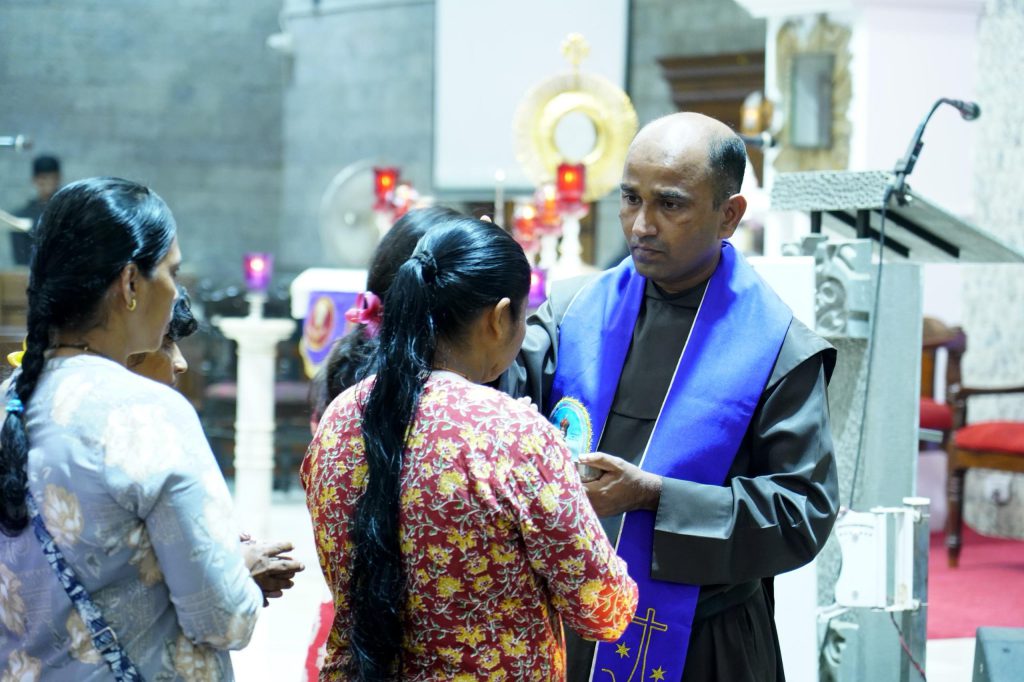
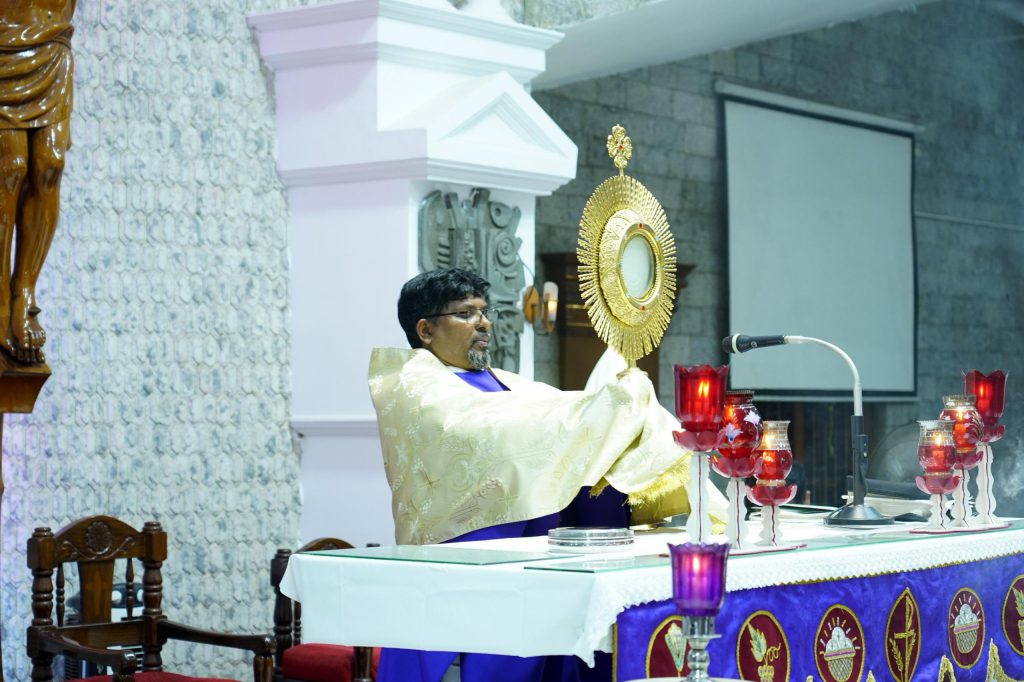
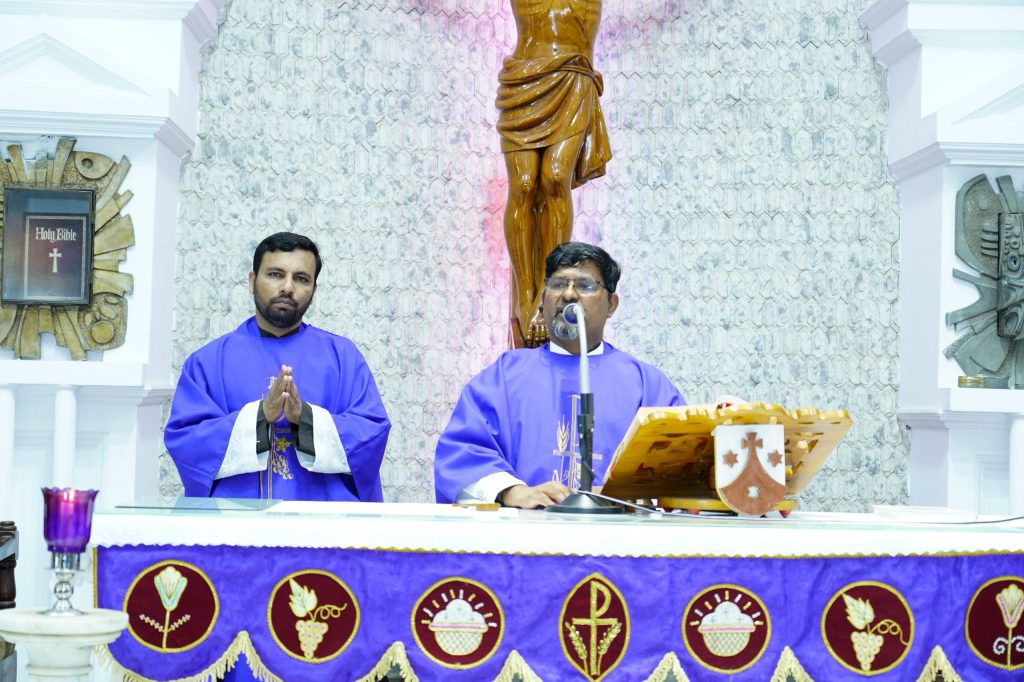
Mangaluru, February 21, 2026: The Infant Jesus Shrine, Bikarnakatte organized a special prayer service on February 21, 2026, invoking God’s blessings upon students appearing for their forthcoming examinations. The programme was aimed at spiritually strengthening students, encouraging disciplined and ethical study habits, and offering reassurance to parents and teachers during a period that is often marked by anxiety and pressure.
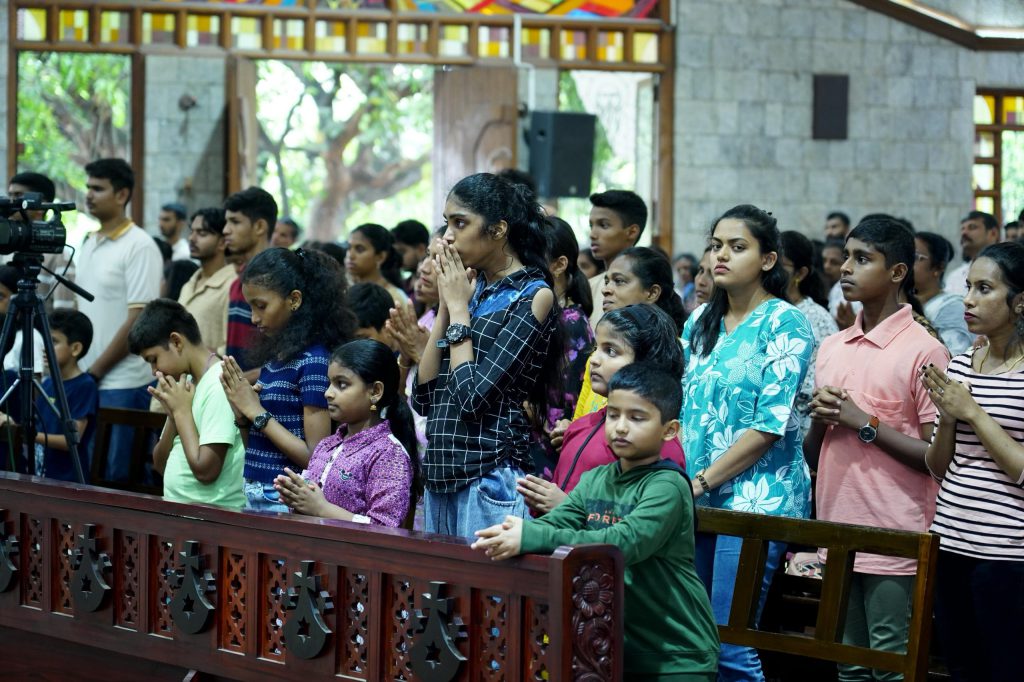
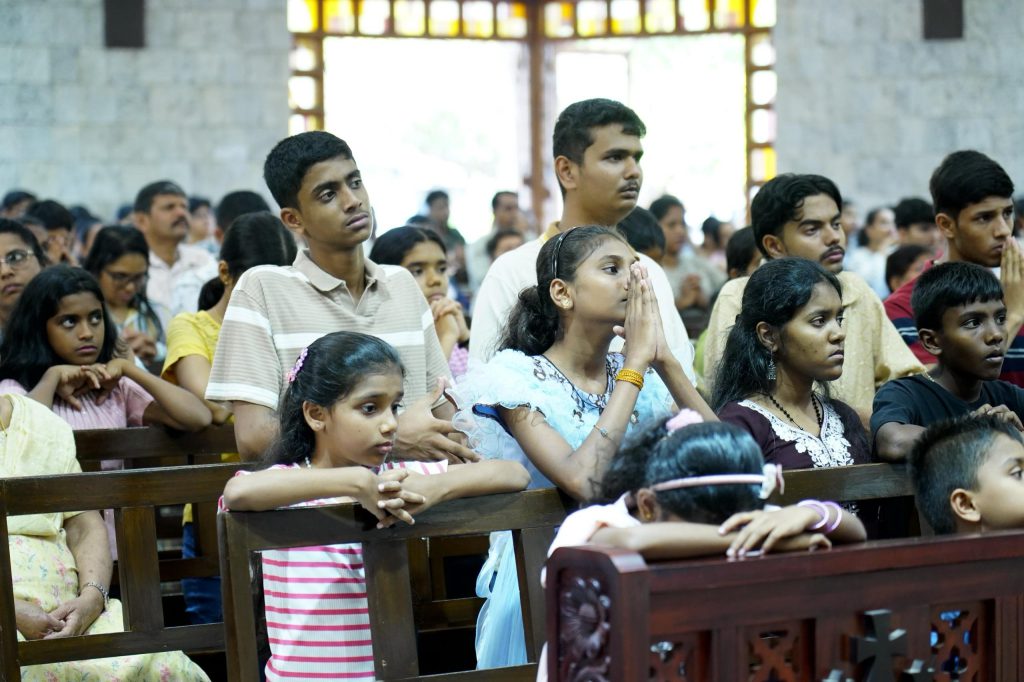
The serene atmosphere of the Shrine was filled with devotion as students, parents, teachers, and devotees gathered in large numbers. One of the distinctive features of the Infant Jesus Shrine is its spirit of inclusiveness. People visit this Shrine irrespective of religion, caste, language, or social background. Over the years, devotees belonging to different faith traditions have found solace and inspiration here. Christians, Hindus, Muslims, and people of other beliefs regularly visit the Shrine seeking peace, strength, healing, and divine guidance. This universal appeal was clearly visible during the prayer service, as families from diverse backgrounds joined together with a shared intention for the well being and success of children.
The Eucharistic celebration was presided over by John Pinto, OCD, who delivered a thoughtful and compassionate homily. Reflecting on the realities faced by students today, he observed that examinations often create stress not only for children but also for parents and teachers. He reminded the gathering that while academic achievement is important, it should never come at the cost of mental peace, moral values, or physical health.
Addressing the students, Fr John Pinto encouraged them to cultivate disciplined habits by preparing a realistic personal timetable and following it with sincerity. He stressed the importance of regular study, timely revision, and adequate rest. He urged students to approach examinations with calmness and confidence rather than fear. Drawing from spiritual wisdom, he explained that faith in the Universal Power that governs the universe enables individuals to rise above anxiety and self doubt.
He emphasized that faith is not blind dependence but a source of inner strength that inspires responsibility, perseverance, and right conduct. According to him, believing in the infinite intelligence that governs the universe helps individuals align their thoughts and actions in a positive direction. When faith is combined with sincere effort and ethical actions, it becomes a powerful force that leads to success and fulfillment. His words resonated deeply with students and parents alike, offering reassurance and hope.
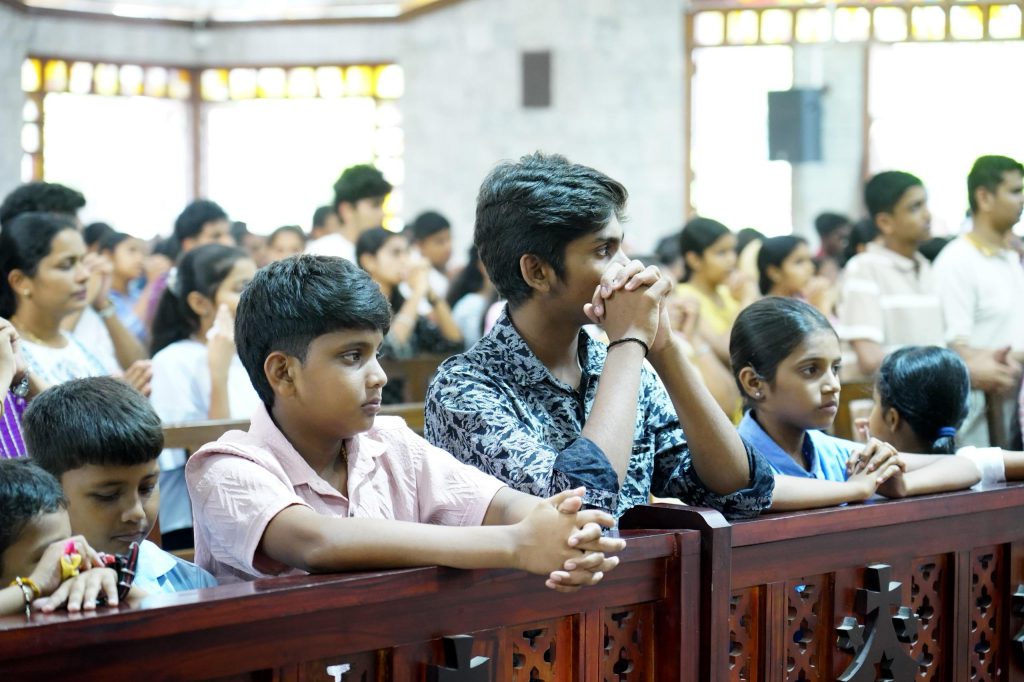
Following the Holy Mass, Eucharistic Adoration was held in an atmosphere of deep silence and prayerful reflection. Special prayers were offered for students preparing for examinations, for parents who support them with dedication and sacrifice, and for teachers who guide and shape young minds. This time of adoration allowed the faithful to pause, reflect, and entrust their concerns and aspirations to God.
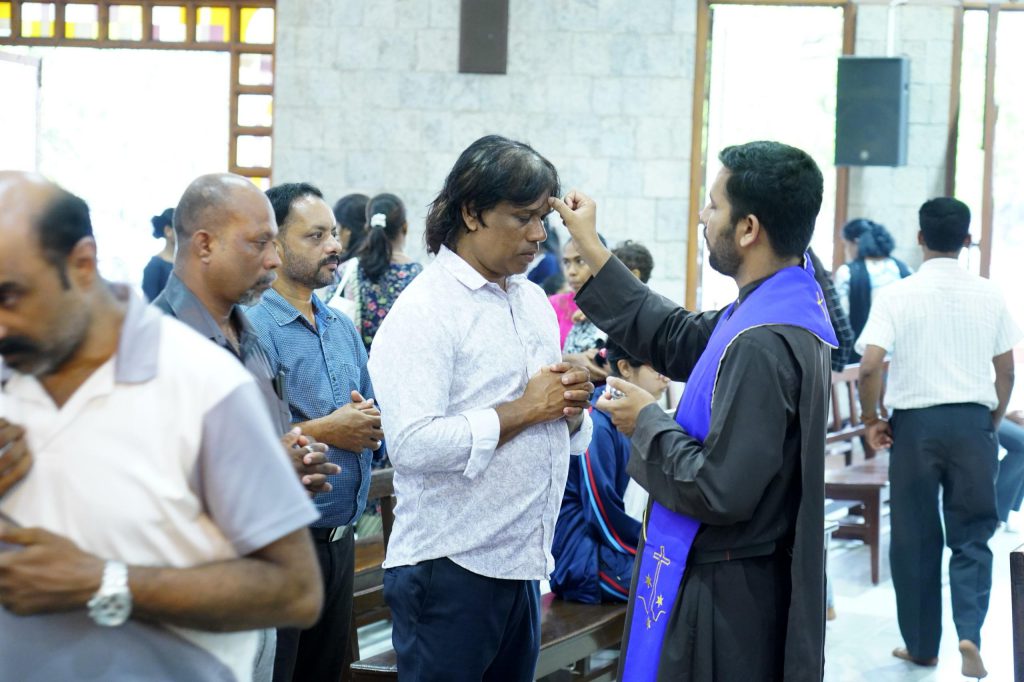
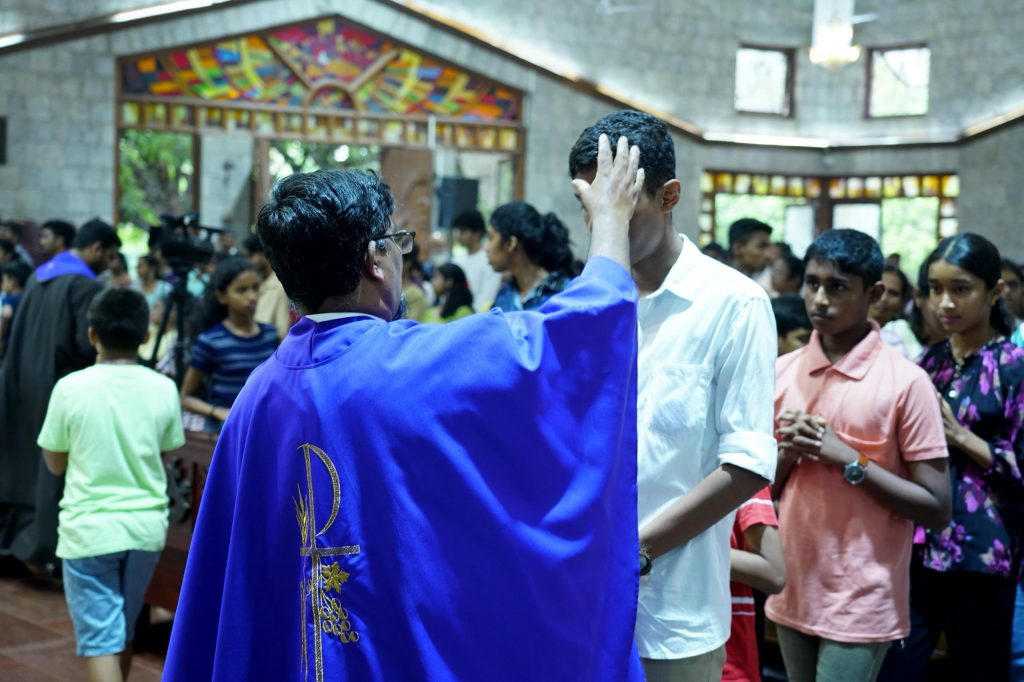
One of the most touching moments of the programme was the anointing and blessing of the children. Each student was anointed with holy oil and individually blessed, invoking God’s grace, wisdom, and guidance upon their academic journey. Parents watched with visible emotion as their children received the blessings. For many families, this moment symbolized reassurance, hope, and renewed confidence as they entrusted the future of their children into God’s loving care.
Addressing the gathering after the service, Stifan Perera, OCD, Director of the Shrine, extended his heartfelt best wishes to all students appearing for their examinations. He encouraged them to face their academic challenges with honesty, confidence, and perseverance. He reminded them that true success is not measured only by marks or ranks, but by the values they uphold and the integrity they display in life. He also acknowledged the vital role played by parents and teachers in nurturing and guiding students.
The Eucharistic celebration was concelebrated by Wilson Tauro, OCD, Vocation Promoter, whose presence added to the spiritual richness of the occasion. Together, the priests highlighted the importance of prayer, guidance, and moral formation in shaping young lives, especially during crucial academic phases.
The prayer service held special significance as the year has been declared the Year of the Children by the Diocese of Mangalore. In this context, the programme stood as a meaningful expression of the Church’s concern for children and young people, recognizing them as the hope of the future and emphasizing the need for holistic care that includes intellectual, emotional, moral, and spiritual growth.
The Infant Jesus Shrine has consistently organized such prayer services at the beginning of the academic year and during examination periods. These initiatives reflect the Shrine’s enduring commitment to supporting students through prayer and pastoral care. Many students and parents have shared that such moments of prayer provide peace of mind, renewed motivation, and clarity during demanding academic times.
A defining characteristic of the Shrine is its universal outlook. People from different walks of life and religious traditions visit the Shrine regularly, especially on Thursdays and during special novenas. Many are drawn not by formal religious affiliation but by a deep belief in a Universal Power and the compassionate presence symbolized by the Infant Jesus. This openness has made the Shrine a spiritual home where human hopes and struggles find expression beyond boundaries of religion or caste.
Faith, at its core, is about trusting the Universal Power that governs the conduct of the universe. Whether one fully understands it or not, an infinite intelligence guides creation and human destiny. By believing in this higher power, individuals are able to draw inner strength, resilience, and clarity of purpose. Faith offers courage during fear, patience during uncertainty, and direction during moments of confusion.
At the same time, the message emphasized throughout the programme was that faith must always be accompanied by ethical actions. Honesty in examinations, discipline in preparation, respect for parents and teachers, and responsibility towards society are essential values. When belief is united with right conduct and sincere effort, it becomes a transformative force that leads not only to academic success but also to meaningful and responsible living.
The active participation of students, parents, and teachers highlighted the strong bond between the Shrine and the wider community. Their presence reflected a shared understanding that education is not merely about intellectual achievement, but about forming character and nurturing values that guide individuals throughout life. The atmosphere was filled with calm assurance and renewed hope. Students left the Shrine with confidence and peace of mind, parents with trust and reassurance, and teachers with encouragement to continue their mission. Once again, the Infant Jesus Shrine, Bikarnakatte, reaffirmed its role as a centre of faith, inclusiveness, encouragement, and spiritual guidance, reminding all that when faith, effort, and ethical living come together, success naturally follows.
“I want to remember your face so that when I meet you in heaven, I can recognize you and say thank you again. “
Selected by:BILL BEN
Indian billionaire Ratan Ji Tata when a radio presenter was asked in a telephone interview: “Sir, what do you remember when you found the happiest happiness in life”?
Ratan ji Tata said: “I have crossed four stages of life, finally I understood the meaning of true happiness. “
The first step is to accumulate wealth and resources. But at this stage I didn’t get the happiness I wanted.
Second phase of collecting valuables and things. But I realized that the effect of this matter is also temporary and the flash of valuable things won’t last long.
Then came the third phase to get the bigger project. Back then I had 95% diesel supply in India and Africa. I am also the owner of the largest steel factory in India and Asia. But even here I didn’t get as much joy as I expected.
Phase four, my friend asked me to buy wheelchairs for some disabled children. There are about 200 children. Bought wheelchairs immediately as per the request of a friend.
But buddy insisted I go with him and provide wheelchairs for the kids. I got ready and went with them. My hands gave wheelchairs to all the deserving kids out there. Strange joy on those kids faces. I saw them all in wheelchairs having fun.
I felt true happiness that day. One of the kids grabbed my leg as I was about to go back from there. I tried to gently free my leg, but the kid wouldn’t let go and he was staring me in the face and holding my leg tight. I leaned over and asked the child: Do you want anything else?
Then the answer that boy told me not only shocked me but changed my outlook on life completely.
The boy said: “I want to remember your face so that when I meet you in heaven, I can recognize you and thank you again. “
Incidents like this remind us that public institutions are ultimately built on individuals who choose to act with responsibility and compassion.
NV Paulose , Chairman, Global TV+91 98441 82044
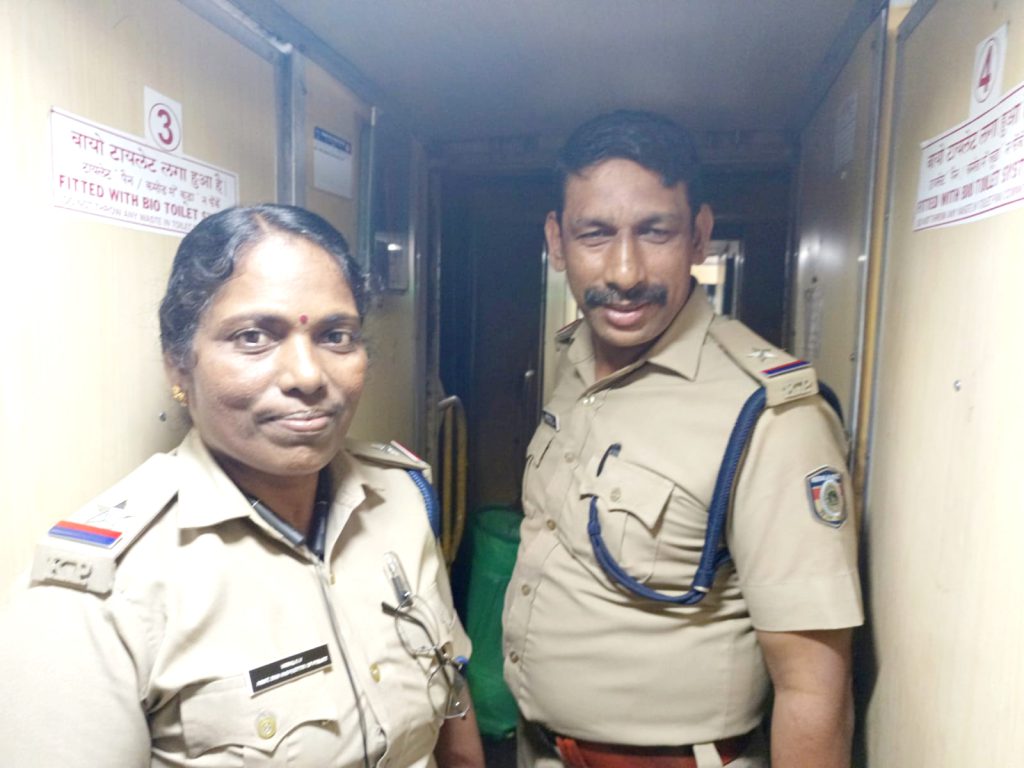
I went up to them to personally congratulate them and took their permission to capture this photograph. I could not resist the urge to thank them on behalf of the entire nation. This is the second time I have personally witnessed the care and professionalism of the Railway Police in Kerala.
The situation this time involved a young woman travelling alone. Her husband grew anxious when she did not respond to his calls. Unbeknownst to him, she had already fallen fast asleep. The time was around 10.30 at night.
Concerned about her safety, he sent a message through the railway messaging system requesting the Railway Police to ensure her well being.
What followed was reassuring and commendable. A male and a female police officer promptly arrived at the compartment. With politeness and sensitivity, they identified the passenger, checked that she was safe and comfortable, and then conveyed a message back to the understandably worried husband, putting his mind at ease.
Was such care absent earlier, or did we misunderstand them then?
Incidents like this remind us that public institutions are ultimately built on individuals who choose to act with responsibility and compassion. These officers did not treat this as a routine duty but as a human concern, and that made all the difference.
In times when trust in systems is often questioned, such actions quietly rebuild confidence and reassure citizens that help is available when it is genuinely needed.
On behalf of Global TV, I congratulate these officers and the entire Railway Police system for their efficiency, empathy, and dedication to duty. As a citizen, I am deeply grateful for the care and concern you showed. Moments like these make me proud to say that all Indians are my brothers and sisters.